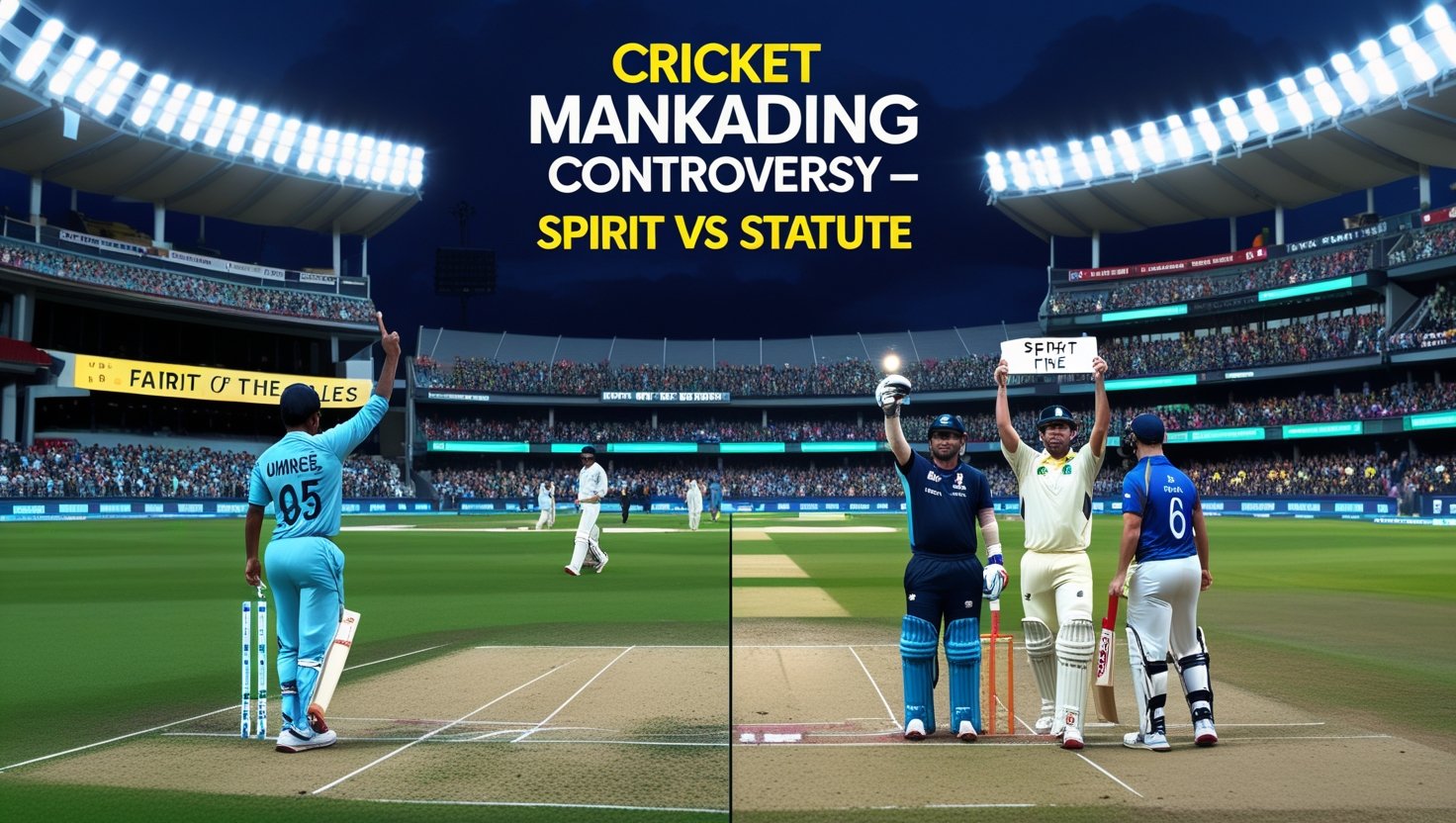
Hold on to your hats, Cricket has a strategy that challenges both the rule book and our gut feelings! In today’s game, the term Mankading resonates not only as a legal dismissal but also as an emotional trigger in public debates. This article dives into the controversy surrounding Mankading, sparking curiosity by questioning if it truly embodies the spirit of the game or strictly follows the statute. As we journey through history, ethics, tactical choices, and cultural sentiments, you’ll understand why this contentious maneuver remains one of cricket’s most debated topics.
A Spark of Controversy:
The origins of Mankading trace back to a time when cricket was evolving from a mere pastime to a structured sport. Named after the legendary Indian cricketer Vinoo Mankad, this method of run out was first recorded in 1947 when Mankad dismissed an opponent by running out a non-striker before delivering the ball. This incident, steeped in both strategy and controversy, has since become synonymous with a clash between orthodox sportsmanship and a calculated legal action.
Historically, Mankading emerged as a countermeasure to protect bowlers from deceitful tactics, such as a non-striker backing up too far to gain an unfair advantage. While the laws of Cricket allow this move, critics argued that it violated the unwritten code of fair play. Today, debates around this practice often revolve around whether its execution honors or undermines the game’s legacy, illustrating the contrast between strictly following the statute and embracing the game’s spirit. Every discussion, whether on match forums or social media, is fueled by a deep-seated respect for cricket’s traditions and a desire to maintain its inherent values.
Beyond the Stumps:
Modern Cricket faces an enduring duality: the conflict between the codified laws and an ethical framework often described as the game’s spirit. On one side of the boundary, we see a legalistic view where every action is measured against the written rules. Mankading fits perfectly in this realm; if the non-striker has left the crease, the dismissal is entirely legal, and the bowler is within their rights to act. A case made in favor of strict adherence to the law argues that, in a sport governed by precise regulations, the written statute must always prevail.
Conversely, many fans and former players believe that Cricket is about more than just the laws. The game embodies sportsmanship, mutual respect, and an unspoken pact among competitors that goes beyond what is written. They suggest that every decision on the field should not only conform to the letter of the law but also respect the game’s deep-rooted traditions and ethical standards. This nuanced debate fuels every discussion around Mankading. Is it a win if it merely follows the rule book, or does it undermine the unwritten trust that binds the sport together?
Ethics in Action:
When a bowler resorts to Mankading, the decision is rarely black and white. On the one hand, it can be seen as a tactical masterstroke that prevents the non-striker from unlawfully gaining an advantage. Proponents argue it is a legitimate strategy in a fiercely competitive environment where every run counts. In moments when a bowler catches the opposition off guard by dismissing a non-striker before even releasing the ball, that action perfectly aligns with the Cricket laws. Here, the statute speaks clearly, and the player is merely exercising legal acumen to claim victory.
On the other hand, critics view Mankading as a tactic too steeped in cunning rather than sportsmanship. They believe that even though the move is legal, it contradicts an unspoken code of honor. Supporters of this view assert that Cricket should carry the elegance of its traditions, where victory isn’t achieved merely through bending the rules, but by playing in a manner that is respectful and graceful. This dichotomy transforms every Mankading incident into a battlefield of ideas: while one camp champions sharp strategy, the other defends the intrinsic spirit of the game.
Cricket’s Whispered Code:
Behind the official rule books and recorded statistics lies a profound, often whispered code of ethics that defines Cricket. This silent consensus embodies what many consider the “soul” of the game, a shared understanding that fair play transcends what is legally enforceable. The notion of spirit in cricket encapsulates aspects like honor, respect for opponents, and a commitment to play fairly. Thus, when incidents such as Mankading occur, they invariably provoke a cultural and ethical introspection that goes far deeper than the law.
This introspection is not just an academic debate, it has real-world consequences on public perceptions. Fans, regardless of explicit knowledge of the legal intricacies, often view Mankading within a moral context. It’s seen as a moment where the natural rhythm of the game is momentarily interrupted by a decision that feels coldly pragmatic. This delicate interplay between the codified statute and the cherished spirit of the game nurtures years of passionate debates among cricket enthusiasts, underscoring the game’s innate complexity and cultural significance.
Unpacking the Interactive Dynamics:
The controversial nature of Mankading is best witnessed when modern Cricket encounters digital scrutiny. High-profile instances, such as the widely discussed incident involving Ravichandran Ashwin and Jos Buttler, have not only sparked heated debates among players and coaches but have reverberated across social media platforms. In today’s interactive era, every tactical decision is dissected by fans globally, with opinions split along ethical and legal lines.
For players, executing Mankading is a calculated risk that might earn them accolades for astuteness or criticism for perceived impudence. The split-second decisions on the field sometimes result in lasting reputational impacts that extend far beyond a single match. Fan backlashes, when such moves are seen as unsportsmanlike, underscore the emotional intensity and unity in values held by the cricket community. Every run-out occasion fueled by Mankading becomes a case study in balancing competitive strategy against maintaining the game’s revered traditions, showing how digital discourse has transformed on-field actions into globally scrutinized events.
On the Horizon:
With the evolving landscape of Cricket, from technological intervention to changing attitudes about sportsmanship, the future of Mankading remains a vibrant topic of discussion. Rule-makers are now more inclined to consider modern interpretations of the game’s ethical dimension while ensuring clarity in the statute. Recent tweaks in the regulations have attempted to streamline the dismissal process, emphasizing that if a non-striker is outside their crease, the act is simply a run-out under the law. These changes illustrate the sport’s commitment to evolving with time while preserving its core values.
Looking forward, the conversation about Mankading is likely to become even more nuanced. As players gain better insights into the complex balance between legality and sportsmanship, innovations in both rule enforcement and equipment technology could further influence decision-making on the field. Coaches and umpires will be at the forefront of interpreting these changes, striving to generate an environment that respects both the written statute and the cherished spirit of the game. This ongoing evolution invites not only changes in regulation but a broader cultural dialogue that could redefine what sportsmanship truly means in Cricket.
Conclusion:
In the end, the controversy of Mankading encapsulates a fundamental clash: the staunch adherence to the written laws versus the enduring call of cricket’s unwritten spirit. While the rules provide a clear legal framework, the passionate debates remind us that Cricket is as much about honor and tradition as it is about decisive tactics. This duality has enriched the game, ensuring that every decision on the field contributes to the ongoing narrative of fairness and competitive spirit.
FAQs:
1. What is Mankading?
It is a legitimate method of run out where a bowler dismisses the non-striker for leaving the crease too early.
2. Is Mankading against the spirit of the game?
While some argue it contradicts cricket’s unwritten rules, it remains entirely legal under the written laws.
3. Who popularized Mankading?
The dismissal is named after Vinoo Mankad, an Indian cricketer who first employed the tactic effectively.
4. What is the difference between the spirit and the statute in cricket?
Spirit refers to the informal ethics and unwritten codes, while statute means the formal, codified rules of the game.
5. How often does Mankading occur in modern cricket?
It is relatively rare but becomes significant whenever it sparks debates about both legal correctness and sportsmanship.
6. Can Mankading affect a player’s reputation?
Yes, reactions to Mankading can polarize opinion, influencing how players are perceived both on and off the field.